
My Neuro-Symbolic Meta-Policies paper was accepted at ISWC 2026
Why I want agents to choose their memory rules, not hide them
Our paper, Neuro-Symbolic Meta-Policies for Temporal Knowledge-Graph Memory under Partial Observability, was accepted at ISWC 2026. I worked on this with Vincent Francois-Lavet and Michael Cochez. I wrote a structured overview on the project page, and the paper itself is on arXiv.
This paper closes a loop I have been circling for a while. In my earlier RoomKG work, I showed that fixed symbolic heuristics over temporal knowledge-graph memory beat end-to-end neural agents by a wide margin. Then I studied which observed facts should be promoted into long-term memory. But one thing stayed fixed the whole time: the heuristics themselves. The agent answered with one predetermined rule, explored with another, and forgot with a third, at every single step, no matter what its memory looked like.
That always bothered me, because no single rule is right everywhere. So the question in this paper is: can an agent learn which rule to apply at each moment, without giving up the property I care about most, which is that every memory operation stays symbolic and inspectable?
What the paper is about
The setting is again RoomKG: a partially observable world where the hidden state and the
observations are RDF graphs, and the agent maintains a bounded long-term memory whose
facts carry the temporal annotations time_added, last_accessed, and num_recalled.
The named heuristics rank over exactly those annotations. For question answering, the agent can trust the most recently added matching fact (MRA), the most recently used one (MRU), or the most frequently used one (MFU). For forgetting, it can evict FIFO, LRU, or LFU. Exploration prioritizes frontiers using the same annotation properties.
A tiny example shows why the choice matters. Say memory contains (sarah, at_location, living) with annotations and (sarah, at_location, kitchen) with
. Asked where Sarah is, MRA answers kitchen, while MRU and MFU answer
living. If she has just moved, only MRA is right. If the older fact keeps getting
confirmed, the usage-based rules are right. A fixed choice is wrong somewhere.
So instead of fixing the rule, we learn a meta-policy: a controller that looks at the current memory graph and selects one named heuristic per function. The selected heuristics are then executed by deterministic symbolic procedures. The neural part only ever chooses among named options. It never replaces symbolic control with an opaque latent action.
The part I find elegant
The controller has to read a variable-size annotated RDF graph, and the annotations are the whole point: the heuristics it chooses among are rankings over those annotation values. So the encoder should be able to see them. We compare three graph encoders that form a natural ladder. A GCN sees only topology. An R-GCN adds relation types. And a StarE-GNN additionally embeds the qualifiers into its messages:
where embeds the temporal annotations of the fact connecting and . Only this last encoder is qualifier-aware, meaning it can condition on the very values the heuristics rank over.
On top of the encoder sit three value heads, one for question answering, one for exploration, one for forgetting. Each head pools the fact embeddings with its own attention,
so the three functions can attend to different parts of the same memory, and each head scores its own named candidates with Q-values trained by standard temporal-difference learning. At test time, selection is greedy.
Why I find the result interesting
At long-term memory capacity 512, the qualifier-aware StarE-GNN configuration reaches 47.28 test QA accuracy, the best held-out result among everything we compared. The R-GCN follows at 47.00 and the plain GCN at 46.04. I like this ordering because it matches the design logic: the more of the annotation structure the encoder can see, the better it selects among heuristics defined over that structure.
The reference points matter too. The strongest fixed symbolic controls reach 45.64 to 46.28, so learned selection buys roughly one to two points over the best fixed rule, and every learned configuration beats every fixed one. The end-to-end neural baselines sit at 11.40 (Transformer) and 9.40 (LSTM) on the same splits. The symbolic memory substrate does the heavy lifting; the meta-policy refines it.
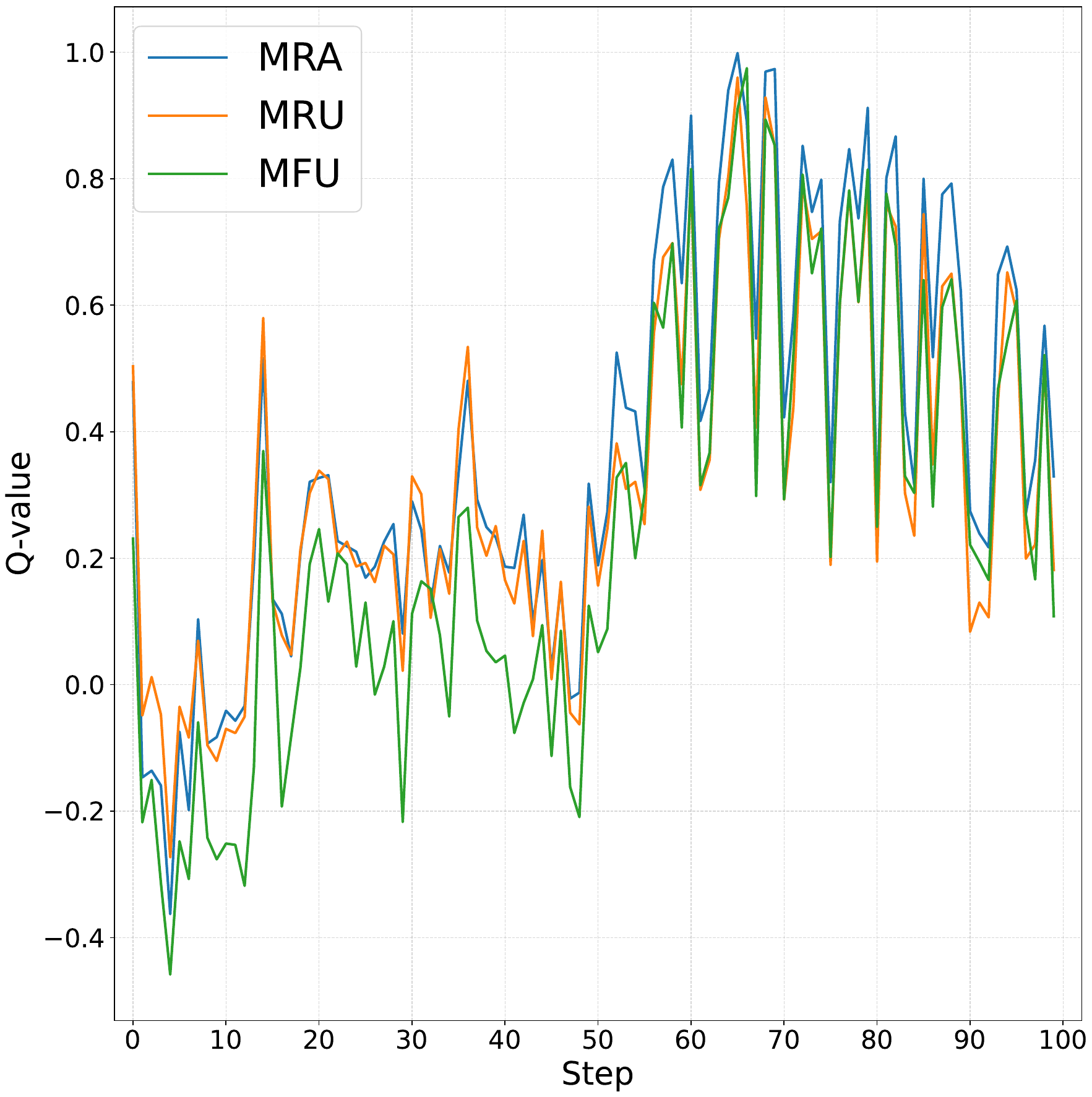
But the number is not my favorite part. My favorite part is that the controller’s behavior can be read. Because the choices are named, we can plot the Q-values of the QA head over an episode and watch the preference shift from MRU early on, when recently accessed facts are still likely relevant, toward MRA later, when the newest observations carry the decisive evidence. That switching is the adaptivity we wanted, and it is visible precisely because the actions are named heuristics rather than latent vectors.
One ablation is worth mentioning. Replacing the three per-function heads with a single learned 27-way head over all heuristic combinations performs clearly worse on train. Factoring the decision by function is the right structure, which I find satisfying: the architecture mirrors how the memory operations are actually organized.
Why this fits the broader project
If you have followed this line of work, the progression is: first, does explicit knowledge-graph memory help at all? Then, which facts deserve to enter long-term memory? And now, which rules should govern the memory at each moment? Storage, transfer, and now rule selection, each isolated and studied as its own concrete problem.
To me this paper is also the clearest statement so far of why I care about neuro-symbolic designs. It is not symbolic structure for its own sake. The result shows that adaptivity and inspectability do not need to be traded off: the learned part makes the agent better, and the symbolic part keeps every decision attributable to a named rule over explicit annotations. Getting to present this at ISWC, the Semantic Web community’s home venue, feels right, because the whole construction rests on RDF representation and annotation-compatible graph semantics.
Links
- Project page: RoomKG Meta-Policies
- Paper: arXiv
- GitHub: roomkg-meta-policies